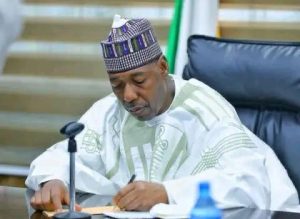

The photograph that has made the rounds this week tells a simpler story than the one we are used to in Nigerian political circles. Here sits Professor Babagana Umara Zulum, the governor of Borno State, dressed in a crisp white agbada and the traditional striped cap that has become his signature. He is not addressing a rally, not touring a displaced persons’ camp, and not making grand gestures for the cameras. He is simply writing. His head is bowed, his pen pressed to paper, a microphone standing by and a bottle of water within reach.
For many Nigerians, especially those outside the Northeast, this image might seem unremarkable. But for those who closely track the grind of governance in the most war-weary state in the country, it is almost symbolic. Governor Zulum is rarely seen behind a desk. His reputation in public discourse is built on his boots-on-the-ground approach—driving into volatile areas, handing out bags of rice himself, and sleeping in tents alongside displaced farmers. That is the Zulum the public knows.
Yet, this week, we are reminded that the real battle for Borno is also fought right here, in these quiet moments of paperwork and signing. The legislative agenda in Maiduguri has been dominated by the nitty-gritty of trying to rebuild a shattered civil service. With the insurgency having decimated local government structures for over a decade, Zulum has been pushing through administrative reforms that aim to bring governance back to the grassroots. The documents he is signing in this image likely relate to the ongoing disbursement of relief funds and the tricky logistical arrangements for resettling thousands of families back into their ancestral towns.
But looking closely at the backdrop of the photo, there is a subtle tension. The green-white-green national flag is draped prominently behind him. It is a reminder that while Borno suffers a unique and brutal crisis, the governor’s office remains tethered to the central government in Abuja. We have seen increased friction this week regarding federal allocations and the security vote. Zulum has famously been outspoken against the military’s tactics and the federal government’s slow pace of reconstruction. The microphone sitting on that desk is not just for public address; it is his weapon of public accountability. He has used it loudly in the past to call out military commanders and federal ministers alike.
What this image really captures, however, is the loneliness of the executive office at this specific tenure. There are no aides hovering over his shoulders in this frame. It is just one man, furrowed brow, doing the paper-heavy work that nobody sees. The public sees the charity distributions; they rarely see the sleepless nights spent figuring out how to pay state workers when federal inflows are delayed.
From a governance perspective, Zulum’s tenure remains one of the most closely watched in the country. He is the exception to the Nigerian political rule—an academic who actually stepped into the trenches, a technocrat who didn’t get swallowed by the political elite. Still, the challenges remain enormous. The recent farming season has been heavily disrupted by renewed attacks, and thousands of farmers are yet to return to their lands. As he sits there, pen in hand, one has to wonder if he is drafting another request for federal intervention, or perhaps setting the stage for the next policy push to tackle the looming food crisis.
In the broader context of Nigerian politics, Borno serves as a grim barometer. If Zulum succeeds in stabilizing his state, it sends a powerful message that governance can survive even the most devastating terrorism. If he fails, it is a stain on the entire federation. For now, the image is a refreshing change of pace from the usual splashy press releases of Nigerian governors. It feels almost like a quiet promise: the ink on these papers might just be more powerful than the bullets that fly outside his constituency.